How AI-Powered Business Intelligence Increases Company Revenue
In today’s hyper-competitive digital economy, companies are no longer struggling with a lack of data—they are overwhelmed by it. Every transaction, customer interaction, and operational process generates vast streams of information. The real challenge lies in transforming this raw data into actionable insights that directly impact revenue. This is where AI-powered Business Intelligence (BI) steps in as a game-changer.
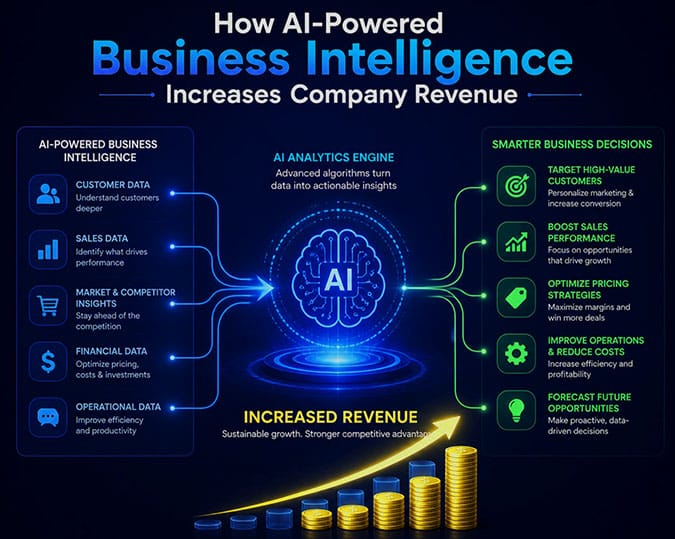
By combining artificial intelligence with traditional BI systems, organizations can uncover deeper insights, predict future trends, and make faster, smarter decisions. The result? Increased efficiency, improved customer experiences, and ultimately, higher revenue.
The Evolution of Business Intelligence
Traditional Business Intelligence tools were designed to analyze historical data and generate reports. While useful, they often required manual input, technical expertise, and significant time to interpret results. This reactive approach meant businesses were always a step behind.
AI-powered BI changes the game by introducing automation, machine learning, and predictive analytics. Instead of simply explaining what happened, AI-driven systems answer critical questions such as:
- What is likely to happen next?
- Why is it happening?
- What actions should we take?
This shift from descriptive to predictive and prescriptive analytics is what makes AI-powered BI so valuable in driving revenue growth.
Turning Data into Revenue Opportunities
One of the most powerful benefits of AI-powered BI is its ability to identify hidden revenue opportunities. By analyzing patterns across large datasets, AI can uncover trends that humans might overlook.
For example, AI can:
- Detect emerging customer preferences
- Identify underperforming products
- Highlight profitable market segments
- Recommend optimal pricing strategies
These insights enable businesses to act proactively, capturing opportunities before competitors even notice them.
Personalization at Scale
Modern customers expect personalized experiences. AI-powered BI allows companies to deliver this at scale by analyzing customer behavior, purchase history, and engagement patterns.
With these insights, businesses can:
- Recommend relevant products
- Tailor marketing campaigns
- Optimize customer journeys
- Increase conversion rates
Personalization directly impacts revenue by boosting customer satisfaction and loyalty. When customers feel understood, they are more likely to make repeat purchases and spend more over time.
Smarter Decision-Making
Revenue growth depends heavily on decision-making speed and accuracy. AI-powered BI enhances both by providing real-time insights and data-driven recommendations.
Executives and managers no longer need to rely on intuition alone. Instead, they can:
- Access dashboards with real-time updates
- Receive automated alerts about critical changes
- Use predictive models to guide strategy
This reduces uncertainty and allows businesses to respond quickly to market changes, minimizing losses and maximizing gains.
Optimizing Pricing Strategies
Pricing is one of the most direct levers for increasing revenue. However, setting the right price is complex and influenced by factors such as demand, competition, and customer behavior.
AI-powered BI systems analyze these variables in real time to recommend optimal pricing strategies. This includes:
- Dynamic pricing based on demand fluctuations
- Competitor price monitoring
- Customer willingness-to-pay analysis
By continuously adjusting prices, companies can maximize profit margins without losing customers.
Enhancing Sales Performance
Sales teams benefit significantly from AI-powered BI. Instead of working with incomplete or outdated data, they gain access to accurate, real-time insights.
AI can:
- Identify high-value leads
- Predict which prospects are most likely to convert
- Suggest the best time to contact customers
- Recommend cross-selling and upselling opportunities
This enables sales teams to focus their efforts where they matter most, increasing conversion rates and boosting revenue.
Improving Operational Efficiency
Revenue growth isn’t just about increasing sales—it’s also about reducing costs and improving efficiency. AI-powered BI helps identify inefficiencies in operations and suggests improvements.
For example:
- Supply chain optimization reduces delays and costs
- Inventory management prevents overstocking or stockouts
- Workforce analytics improve productivity
By streamlining operations, businesses can allocate resources more effectively, increasing profitability.
Predictive Analytics for Future Growth
One of the most powerful features of AI-powered BI is predictive analytics. By analyzing historical data, AI can forecast future trends with remarkable accuracy.
This allows companies to:
- Anticipate market demand
- Plan inventory and production
- Allocate budgets more effectively
- Identify potential risks before they occur
Predictive insights give businesses a competitive edge, enabling them to stay ahead of the curve and capitalize on future opportunities.
Real-Time Insights for Agile Businesses
In fast-moving industries, timing is everything. AI-powered BI provides real-time insights that allow businesses to act instantly.
For instance:
- Retailers can adjust promotions based on live sales data
- E-commerce platforms can optimize product recommendations in real time
- Financial institutions can detect fraud as it happens
This agility ensures that businesses can respond quickly to changing conditions, protecting revenue and seizing new opportunities.
Breaking Down Data Silos
Many organizations struggle with data silos, where information is stored in separate systems and departments. This fragmentation limits visibility and reduces the effectiveness of decision-making.
AI-powered BI integrates data from multiple sources, creating a unified view of the business. This holistic perspective enables better collaboration and more informed decisions.
When teams have access to the same insights, they can align their strategies and work toward common revenue goals.
Democratizing Data Access
Traditionally, data analysis was limited to technical experts. AI-powered BI democratizes access to data by making it more user-friendly and accessible.
Features such as natural language processing allow users to ask questions in plain English and receive instant insights. This empowers employees across all levels to make data-driven decisions.
When more people in an organization can leverage data effectively, it leads to smarter strategies and improved performance.
Enhancing Marketing ROI
Marketing is a major driver of revenue, and AI-powered BI significantly improves its effectiveness. By analyzing campaign performance and customer behavior, AI provides insights that optimize marketing strategies.
Businesses can:
- Identify the most effective channels
- Target the right audience segments
- Allocate budgets more efficiently
- Measure ROI with precision
This ensures that every marketing dollar contributes to revenue growth.
Strengthening Customer Retention
Acquiring new customers is expensive, but retaining existing ones is highly profitable. AI-powered BI helps businesses understand customer behavior and identify signs of churn.
With these insights, companies can:
- Implement targeted retention strategies
- Offer personalized incentives
- Improve customer support
- Enhance overall experience
By reducing churn and increasing customer lifetime value, businesses can significantly boost revenue.
Challenges and Considerations
While AI-powered BI offers immense benefits, it also comes with challenges. Organizations must address issues such as:
- Data quality and accuracy
- Integration with existing systems
- Privacy and security concerns
- Employee training and adoption
Successfully implementing AI-powered BI requires a strategic approach and a commitment to continuous improvement.
The Future of AI-Powered Business Intelligence
As AI technology continues to evolve, its impact on Business Intelligence will only grow stronger. Future advancements may include:
- More advanced predictive and prescriptive analytics
- Greater automation of decision-making processes
- Enhanced integration with emerging technologies
- Improved user interfaces and accessibility
Businesses that embrace these innovations will be better positioned to thrive in an increasingly data-driven world.
Conclusion
AI-powered Business Intelligence is not just a technological upgrade—it is a fundamental shift in how organizations operate and compete. By transforming data into actionable insights, AI enables businesses to make smarter decisions, optimize operations, and deliver exceptional customer experiences.
The result is clear: increased efficiency, stronger customer relationships, and most importantly, higher revenue. Companies that leverage AI-powered BI effectively will not only survive in today’s competitive landscape—they will lead it.