Cloud Business Intelligence Solutions for Large-Scale Data Management
In the modern digital economy, data has become one of the most valuable assets for organizations. As businesses expand and digital interactions multiply, the volume, velocity, and variety of data continue to grow at an unprecedented rate. Managing this large-scale data effectively is no longer optional—it is essential for maintaining competitiveness. This is where Cloud Business Intelligence (BI) solutions play a transformative role.
Cloud Business Intelligence refers to the use of cloud-based technologies to collect, process, analyze, and visualize data. Unlike traditional BI systems that rely on on-premise infrastructure, cloud BI solutions offer scalability, flexibility, and cost efficiency, making them ideal for handling large-scale data management challenges.
The Rise of Large-Scale Data
Organizations today generate data from numerous sources: customer interactions, social media platforms, IoT devices, transaction systems, and more. This data is often unstructured and distributed across multiple systems, making it difficult to analyze using conventional tools.
Large-scale data management involves handling datasets that are too massive or complex for traditional data processing systems. These datasets require advanced storage, processing power, and analytical capabilities. Cloud BI solutions are specifically designed to meet these demands, enabling organizations to turn raw data into actionable insights.
Key Features of Cloud BI Solutions
Cloud BI platforms offer a range of features that make them suitable for large-scale data environments:
1. Scalability
One of the most significant advantages of cloud BI is its ability to scale resources up or down based on demand. Organizations can handle sudden spikes in data volume without investing in additional hardware.
2. Real-Time Data Processing
Modern cloud BI tools support real-time or near real-time data processing. This allows businesses to make timely decisions based on the latest information, which is crucial in fast-paced industries.
3. Data Integration
Cloud BI solutions can integrate data from multiple sources, including databases, APIs, and third-party applications. This creates a unified data ecosystem, eliminating silos and improving data consistency.
4. Advanced Analytics
With built-in machine learning and AI capabilities, cloud BI platforms enable predictive analytics, trend analysis, and anomaly detection. These features help organizations anticipate future outcomes and optimize strategies.
5. Accessibility
Being cloud-based, these tools can be accessed from anywhere with an internet connection. This supports remote work environments and enhances collaboration across teams.
Benefits for Large-Scale Data Management
Cost Efficiency
Traditional BI systems require significant upfront investment in infrastructure, maintenance, and upgrades. Cloud BI operates on a subscription-based model, reducing capital expenditure and shifting costs to operational expenses.
Faster Deployment
Cloud BI solutions can be deployed quickly compared to on-premise systems. Organizations can start analyzing data within days instead of months, accelerating time-to-value.
Improved Data Governance
Cloud platforms often include robust security features such as encryption, access controls, and compliance certifications. This ensures that sensitive data is protected while maintaining regulatory compliance.
Enhanced Collaboration
Cloud BI tools enable multiple users to access and analyze data simultaneously. Shared dashboards and reports foster collaboration and ensure that everyone is working with the same data.
Flexibility and Innovation
Cloud environments support continuous updates and integration with emerging technologies. This allows organizations to innovate without being constrained by legacy systems.
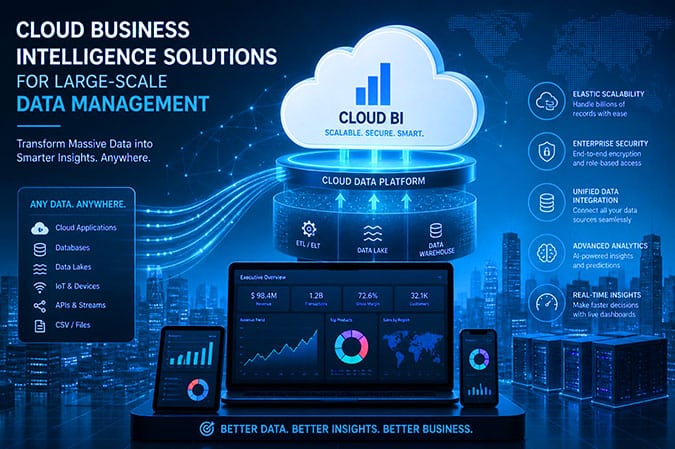
Architecture of Cloud BI Systems
A typical cloud BI architecture consists of several layers:
Data Sources Layer
This includes all the sources from which data is collected, such as CRM systems, ERP systems, social media platforms, and IoT devices.
Data Ingestion Layer
Data is extracted from various sources and loaded into the cloud environment. This can be done in batches or in real-time using streaming technologies.
Data Storage Layer
Cloud storage solutions such as data lakes and data warehouses store large volumes of structured and unstructured data. These systems are designed for high availability and durability.
Data Processing Layer
Data is cleaned, transformed, and processed using tools like distributed computing frameworks. This layer ensures that data is ready for analysis.
Analytics Layer
This is where data analysis takes place. Users can create dashboards, run queries, and apply advanced analytics to derive insights.
Visualization Layer
Data is presented in the form of charts, graphs, and interactive dashboards, making it easier for decision-makers to understand and act on insights.
Challenges and Considerations
While cloud BI offers numerous advantages, organizations must also address certain challenges:
Data Security and Privacy
Storing data in the cloud raises concerns about security and privacy. Organizations must ensure that their cloud provider complies with industry standards and regulations.
Data Migration
Migrating large volumes of data from on-premise systems to the cloud can be complex and time-consuming. Proper planning and execution are essential to avoid data loss or downtime.
Vendor Lock-In
Relying heavily on a single cloud provider can lead to vendor lock-in, making it difficult to switch providers in the future. Organizations should consider multi-cloud strategies to mitigate this risk.
Performance Optimization
Handling large-scale data requires optimized queries and efficient data models. Poorly designed systems can lead to slow performance and increased costs.
Best Practices for Implementation
To maximize the benefits of cloud BI solutions, organizations should follow these best practices:
Define Clear Objectives
Identify the business goals and key performance indicators (KPIs) that the BI system will support. This ensures that the implementation aligns with organizational needs.
Choose the Right Tools
Select cloud BI platforms that offer the features and capabilities required for your specific use case. Consider factors such as scalability, integration, and ease of use.
Ensure Data Quality
High-quality data is essential for accurate analysis. Implement data cleansing and validation processes to maintain data integrity.
Train Users
Provide training to employees to ensure they can effectively use the BI tools. This increases adoption and maximizes the return on investment.
Monitor and Optimize
Continuously monitor system performance and usage. Optimize queries, storage, and processing to improve efficiency and reduce costs.
Future Trends in Cloud BI
The future of cloud BI is shaped by several emerging trends:
Artificial Intelligence Integration
AI-powered analytics will become more prevalent, enabling automated insights and decision-making.
Edge Computing
Processing data closer to its source will reduce latency and improve real-time analytics capabilities.
Data Democratization
More user-friendly tools will empower non-technical users to analyze data, making insights accessible across the organization.
Hybrid and Multi-Cloud Strategies
Organizations will adopt hybrid and multi-cloud approaches to increase flexibility and reduce dependency on a single provider.
Enhanced Data Visualization
Advanced visualization techniques, including augmented and virtual reality, will provide more immersive data exploration experiences.
Conclusion
Cloud Business Intelligence solutions have revolutionized the way organizations manage and analyze large-scale data. By offering scalability, flexibility, and advanced analytics capabilities, these solutions enable businesses to harness the full potential of their data.
As data continues to grow in complexity and volume, adopting cloud BI is no longer just an option—it is a strategic necessity. Organizations that embrace these technologies will be better equipped to make informed decisions, drive innovation, and maintain a competitive edge in an increasingly data-driven world.
Investing in the right cloud BI strategy today can unlock powerful insights tomorrow, transforming data from a challenge into a valuable asset for sustainable growth.