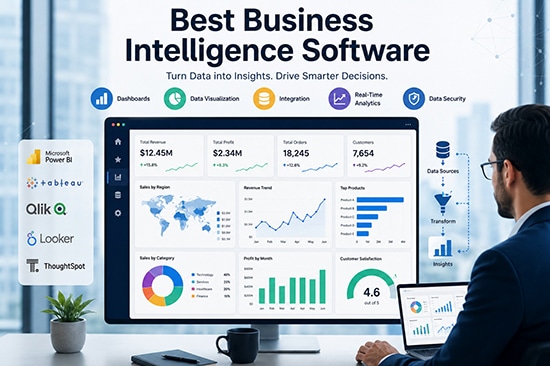
In today’s competitive digital economy, businesses generate enormous amounts of data every day. Sales transactions, customer interactions, website traffic, financial reports, marketing campaigns, and operational activities all create valuable information. However, collecting data is not enough. Companies need effective tools to transform raw information into meaningful insights.
This is where Business Intelligence (BI) software becomes essential.
The best business intelligence software helps organizations collect, organize, analyze, and visualize data. Instead of spending hours reviewing spreadsheets and manually preparing reports, business leaders can use interactive dashboards, automated reports, and data visualizations to make faster and smarter decisions.
Whether you run a small business, a growing startup, or a large enterprise, choosing the right BI platform can improve efficiency and provide a significant competitive advantage.
What Is Business Intelligence Software?
Business Intelligence software is a technology platform designed to analyze business data and present the results in an easy-to-understand format. These tools typically combine data from multiple sources and transform it into reports, charts, graphs, dashboards, and other visualizations.
For example, a company may store sales information in one system, customer information in another platform, and marketing data in several online tools. Business intelligence software can connect these sources and create a centralized view of business performance.
A typical BI platform may include features such as:
- Interactive dashboards
- Data visualization
- Automated reporting
- Data integration
- Real-time analytics
- Predictive analytics
- KPI monitoring
- Self-service analytics
- Artificial intelligence and machine learning capabilities
The main goal is simple: help businesses turn complex data into actionable insights.
Why Businesses Need Business Intelligence Tools
Modern organizations operate in an environment where decisions need to be made quickly. Relying entirely on manual reports can be slow and inefficient.
Business intelligence tools allow decision-makers to access important information in real time. Instead of waiting for an analyst to prepare a monthly report, managers can open a dashboard and immediately review sales performance, customer trends, or operational metrics.
BI software can also help companies identify problems before they become more serious.
For example, a dashboard might reveal that sales are declining in a specific region. Management can investigate the issue and take action before the problem affects overall business performance.
Other important benefits include:
Faster Decision-Making
Business intelligence platforms provide quick access to important data. Executives and managers can make informed decisions based on current information rather than assumptions.
Improved Data Accuracy
A centralized BI system can reduce the risk of using outdated or inconsistent information from multiple spreadsheets and databases.
Better Customer Understanding
Businesses can analyze customer behavior, purchasing patterns, preferences, and engagement. These insights can support more effective marketing and customer service strategies.
Increased Operational Efficiency
Companies can identify inefficient processes, unnecessary expenses, and performance bottlenecks.
Competitive Advantage
Organizations that understand their data can often respond more quickly to market changes and new opportunities.
Best Business Intelligence Software Options
There are many business intelligence platforms available today. The best choice depends on your company’s size, budget, technical requirements, and existing technology infrastructure.
Microsoft Power BI
Microsoft Power BI is one of the most popular business intelligence platforms in the market. It is widely used because of its powerful analytics capabilities and integration with the Microsoft ecosystem.
Power BI allows users to connect to multiple data sources and create interactive dashboards and reports. It is particularly useful for organizations already using tools such as Excel, Azure, and other Microsoft services.
One of its biggest advantages is accessibility. Business users can create visual reports without requiring advanced programming knowledge, although technical users can also take advantage of more advanced data modeling features.
Power BI is suitable for small businesses, medium-sized companies, and large enterprises.
Tableau
Tableau is well known for its advanced data visualization capabilities. It allows users to transform complex datasets into interactive charts, graphs, and dashboards.
One of Tableau’s strengths is its ability to explore data visually. Users can interact with information and discover patterns that may be difficult to identify in traditional spreadsheets.
Tableau is often used by data analysts, researchers, and organizations that require detailed visual analytics.
For companies that place a strong emphasis on storytelling through data, Tableau can be an excellent choice.
Google Looker
Google Looker is a business intelligence and data analytics platform designed to help organizations explore and analyze data across their operations.
It is especially useful for companies that work extensively with cloud infrastructure and large datasets. Looker provides tools for building dashboards, analyzing metrics, and creating a consistent data model across an organization.
Businesses can use Looker to create a centralized approach to analytics, helping different teams work with the same definitions and measurements.
This can be particularly valuable for large organizations where inconsistent reporting can create confusion.
Qlik Sense
Qlik Sense is another powerful business intelligence solution that focuses on interactive analytics and data exploration.
The platform allows users to explore relationships between different datasets. Instead of following a strictly predefined path through reports, users can investigate data freely and discover connections that might otherwise remain hidden.
Qlik Sense can be useful for organizations that need flexible analytics and self-service reporting.
Its interactive approach makes it possible for users to ask new questions as they explore the data.
SAP BusinessObjects
SAP BusinessObjects is an enterprise-focused business intelligence solution designed for organizations that require extensive reporting and analytics capabilities.
It can support large volumes of business data and complex reporting environments. Companies already using SAP technologies may find integration particularly valuable.
SAP BusinessObjects is often more suitable for larger organizations with dedicated IT and analytics teams.
How to Choose the Best Business Intelligence Software
Selecting the best business intelligence software requires more than simply choosing the platform with the most features.
Start by identifying your business goals.
Do you need better sales reporting? Customer analytics? Financial dashboards? Marketing performance tracking? Real-time operational monitoring?
Once you understand your objectives, consider the following factors.
Ease of Use
A powerful platform is not useful if employees cannot understand how to use it. Look for software with an intuitive interface and self-service analytics features.
Data Integration
Your BI platform should connect easily with your existing databases, cloud services, CRM systems, accounting software, and other important applications.
Scalability
Your data requirements may grow as your business expands. Choose a solution that can support additional users, larger datasets, and more complex analytics in the future.
Security
Business data can include sensitive financial, customer, and operational information. Strong security features, access controls, and data governance are important considerations.
Pricing
Consider not only the initial subscription cost but also implementation, training, maintenance, and potential expansion costs.
Artificial Intelligence Capabilities
Modern BI platforms increasingly include AI-powered features such as automated insights, natural language queries, anomaly detection, and predictive analytics.
These capabilities can help users discover useful information without manually analyzing every dataset.
The Future of Business Intelligence
Business intelligence software continues to evolve as artificial intelligence, cloud computing, and automation become more advanced.
Traditional reporting is gradually being replaced by more interactive and intelligent analytics experiences. Instead of simply showing what happened in the past, modern BI platforms are increasingly helping businesses understand why something happened and what may happen next.
AI-powered analytics can identify unusual patterns, predict future trends, and provide automated recommendations.
Another important trend is the growth of self-service business intelligence. More employees are gaining access to analytics tools without depending entirely on IT or data specialists.
This democratization of data can help organizations become more agile and data-driven.
Conclusion
The best business intelligence software can transform the way an organization uses data. Platforms such as Power BI, Tableau, Google Looker, Qlik Sense, and SAP BusinessObjects offer different strengths and capabilities for different types of businesses.
The right choice depends on your specific requirements, including budget, existing technology, data complexity, security needs, and the technical skills of your team.
A successful BI strategy is not only about purchasing software. Businesses should also focus on data quality, employee training, clear performance metrics, and effective data governance.
When implemented correctly, business intelligence software can provide valuable insights, improve decision-making, increase efficiency, and help organizations discover new opportunities.
In a business environment where data has become one of the most valuable assets, investing in the right business intelligence platform can be an important step toward long-term growth and success.