Best Business Intelligence Platforms for Small Businesses
In today’s digital economy, data is one of the most valuable assets a company can possess. Small businesses generate data every day through sales transactions, marketing campaigns, customer interactions, website analytics, and inventory management. However, collecting data alone is not enough. The real advantage comes from understanding and using that information effectively. This is where Business Intelligence (BI) platforms become essential.
Business Intelligence platforms help companies gather, analyze, visualize, and interpret data so they can make smarter business decisions. While BI software was once designed primarily for large enterprises with extensive budgets, modern solutions have become affordable, user-friendly, and highly accessible for small businesses.
Choosing the right BI platform can improve productivity, uncover profitable opportunities, reduce operational costs, and provide deeper insights into customer behavior. This article explores the best Business Intelligence platforms for small businesses and explains how each solution can help growing companies thrive in a competitive market.
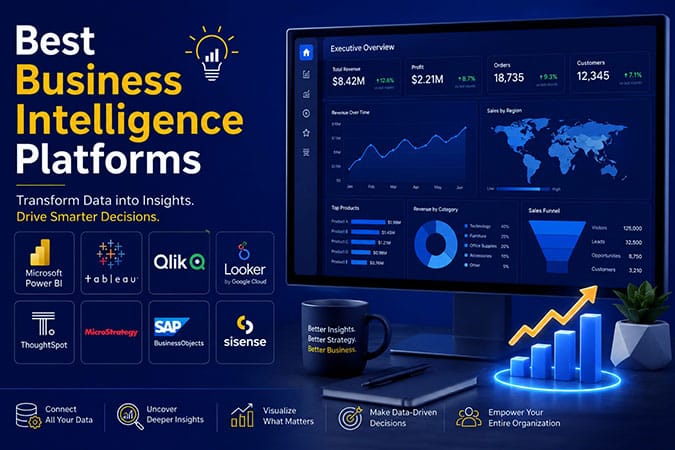
Why Small Businesses Need Business Intelligence Platforms
Many small business owners rely on spreadsheets and manual reporting methods. Although spreadsheets can handle simple tasks, they become difficult to manage as businesses grow. BI platforms automate reporting processes and provide real-time insights that allow businesses to react quickly to changes.
A strong BI solution can help small businesses:
- Track sales performance
- Monitor marketing campaigns
- Improve customer retention
- Analyze financial data
- Forecast future trends
- Optimize inventory management
- Increase operational efficiency
Instead of spending hours manually preparing reports, business owners can focus on strategic growth and decision-making.
Key Features to Look for in a BI Platform
Before selecting a Business Intelligence platform, small businesses should evaluate several important features.
Ease of Use
Small businesses often lack dedicated IT departments. A BI platform should have a simple interface with drag-and-drop functionality and easy dashboard creation.
Data Integration
The platform should connect smoothly with tools such as accounting software, CRM systems, e-commerce platforms, and marketing applications.
Real-Time Analytics
Access to live data enables businesses to make faster and more accurate decisions.
Custom Dashboards
Customizable dashboards allow teams to monitor the metrics most relevant to their goals.
Scalability
A BI solution should grow alongside the business without requiring a complete system replacement.
Affordability
Budget matters for small businesses. Flexible pricing plans and low implementation costs are critical considerations.
Microsoft Power BI
Microsoft Power BI is widely regarded as one of the best BI tools for small businesses due to its affordability, flexibility, and integration capabilities.
Power BI allows users to connect data from multiple sources, including Excel spreadsheets, cloud services, and databases. Its interactive dashboards provide real-time visualizations that simplify complex data analysis.
One major advantage of Power BI is its seamless integration with other Microsoft products such as Excel, Teams, and Azure. Small businesses already using Microsoft tools can adopt Power BI with minimal learning challenges.
Pros
- Affordable pricing
- Strong data visualization tools
- Excellent Microsoft ecosystem integration
- AI-powered insights
- Cloud-based accessibility
Cons
- Some advanced features require technical knowledge
- Complex datasets may require optimization
Power BI is especially suitable for small businesses seeking a scalable solution with advanced analytics capabilities.
Tableau
Tableau is famous for its exceptional data visualization capabilities. It transforms raw data into interactive charts, graphs, and dashboards that are easy to understand.
Small businesses appreciate Tableau for its intuitive interface and ability to handle large datasets efficiently. The platform supports data blending from multiple sources and enables deep analytical exploration.
Tableau also offers mobile-friendly dashboards, making it easy for business owners to monitor performance on the go.
Pros
- Industry-leading visualizations
- User-friendly design
- Strong community support
- Excellent data exploration features
Cons
- Higher pricing compared to competitors
- Advanced functionality may require training
For businesses prioritizing visual storytelling and advanced analytics, Tableau remains an excellent choice.
Google Looker Studio
Google Looker Studio, formerly known as Google Data Studio, is a free BI and reporting platform ideal for startups and small businesses with limited budgets.
Looker Studio integrates perfectly with Google services such as Google Analytics, Google Ads, YouTube, and Google Sheets. Users can create interactive reports and share them easily with teams or clients.
Because it is cloud-based and highly collaborative, Looker Studio works particularly well for digital marketing agencies and online businesses.
Pros
- Free to use
- Strong Google ecosystem integration
- Easy collaboration
- Simple dashboard creation
Cons
- Limited advanced analytics features
- Performance may slow with large datasets
Small businesses focused on digital marketing and web analytics often find Looker Studio more than sufficient for their needs.
Qlik Sense
Qlik Sense is another powerful Business Intelligence platform designed to simplify data exploration and visualization.
Its unique associative engine allows users to discover hidden relationships within datasets that traditional query-based tools may overlook. Qlik Sense uses AI-assisted analytics to generate insights automatically.
The platform supports self-service analytics, enabling non-technical users to create dashboards without coding knowledge.
Pros
- AI-driven analytics
- Flexible dashboard customization
- Strong data discovery tools
- Self-service functionality
Cons
- Can be expensive for very small businesses
- Learning curve for advanced features
Qlik Sense is ideal for businesses seeking advanced data discovery and predictive insights.
Zoho Analytics
Zoho Analytics is an affordable BI solution specifically designed for small and medium-sized businesses.
The platform provides drag-and-drop report creation, automated data syncing, and AI-powered assistant features. Zoho Analytics connects with many popular applications, including QuickBooks, Shopify, Salesforce, and Google Workspace.
One of its biggest advantages is pricing. Small businesses can access robust analytics features without significant financial investment.
Pros
- Budget-friendly
- Easy setup
- Wide integration support
- AI-powered analytics assistant
Cons
- Limited advanced customization
- Some integrations require additional setup
For small businesses seeking simplicity and affordability, Zoho Analytics is a highly practical option.
Sisense
Sisense is a modern BI platform known for its flexibility and embedded analytics capabilities.
It allows businesses to combine data from multiple sources into a single centralized platform. Sisense supports advanced analytics and machine learning features while maintaining a user-friendly interface.
Many small businesses use Sisense to deliver analytics directly to customers through embedded dashboards and reports.
Pros
- Powerful data integration
- Embedded analytics capabilities
- Scalable architecture
- Strong performance with large datasets
Cons
- Pricing may be high for startups
- Advanced features require technical expertise
Sisense is well-suited for businesses planning long-term growth and complex data operations.
Domo
Domo is a cloud-based BI platform that emphasizes real-time data visibility and collaboration.
The platform connects to hundreds of data sources and provides highly interactive dashboards. Domo also includes workflow automation and mobile accessibility features.
Its ability to centralize company data into a single platform makes it valuable for businesses managing multiple departments or remote teams.
Pros
- Real-time analytics
- Extensive integration options
- Mobile-friendly dashboards
- Strong collaboration tools
Cons
- Premium pricing
- May offer more features than smaller businesses need
Domo is best for businesses seeking enterprise-level capabilities with cloud-based convenience.
How to Choose the Right BI Platform
Selecting the best BI platform depends on a business’s goals, technical skills, and budget.
A small retail company may prioritize inventory tracking and sales forecasting, while a marketing agency may focus more on campaign analytics and customer engagement metrics.
When evaluating BI tools, businesses should consider:
- Current business size
- Future growth expectations
- Existing software ecosystem
- Team technical expertise
- Reporting requirements
- Budget limitations
Most BI vendors offer free trials, which allow businesses to test features before making a final decision.
The Future of Business Intelligence for Small Businesses
Business Intelligence technology continues to evolve rapidly. Artificial intelligence, machine learning, and predictive analytics are becoming standard features in modern BI platforms.
Small businesses now have access to tools that were once available only to large corporations. Automated insights, natural language queries, and AI-generated recommendations are making analytics easier than ever.
Cloud computing has also lowered costs and improved accessibility. Teams can collaborate remotely and access dashboards from virtually anywhere.
As competition increases across industries, data-driven decision-making will become even more important. Small businesses that embrace Business Intelligence tools today will be better positioned for long-term growth and success.
Conclusion
Business Intelligence platforms are no longer optional for small businesses aiming to compete effectively in modern markets. These tools provide valuable insights that help organizations improve operations, understand customers, and make smarter strategic decisions.
Platforms such as Microsoft Power BI, Tableau, Google Looker Studio, Qlik Sense, Zoho Analytics, Sisense, and Domo each offer unique advantages tailored to different business needs.
The ideal solution depends on budget, technical requirements, scalability, and company objectives. By investing in the right BI platform, small businesses can transform raw data into actionable intelligence and build a stronger foundation for future success.