Top Business Intelligence Tools for Financial Reporting and Data Analytics
In today’s competitive digital economy, businesses generate enormous amounts of financial and operational data every day. Companies that can transform this raw information into actionable insights gain a significant advantage in decision-making, forecasting, budgeting, and performance tracking. This is where Business Intelligence (BI) tools become essential.
Business Intelligence platforms help organizations collect, analyze, visualize, and interpret data from multiple sources. For finance teams, these tools improve reporting accuracy, automate repetitive tasks, and provide real-time visibility into key financial metrics. Whether you are a startup, a mid-sized business, or a large enterprise, choosing the right BI software can dramatically improve financial reporting and data analytics efficiency.
This article explores the top business intelligence tools for financial reporting and data analytics, their features, benefits, and how they help modern organizations make smarter decisions.
Why Business Intelligence Matters in Financial Reporting
Traditional financial reporting methods often rely heavily on spreadsheets and manual data entry. While spreadsheets remain useful, they can become inefficient and error-prone when handling large datasets. BI tools solve these problems by automating data integration and visualization.
Key advantages of BI software include:
- Real-time financial insights
- Faster report generation
- Improved forecasting accuracy
- Better compliance monitoring
- Interactive dashboards
- Automated data consolidation
- Enhanced collaboration between departments
Modern finance professionals no longer need to spend days preparing reports manually. Instead, they can focus on analyzing trends and creating strategic plans.
1. Microsoft Power BI
Microsoft Power BI is one of the most popular business intelligence platforms in the world. It is widely used for financial reporting because of its affordability, flexibility, and integration with Microsoft products.
Key Features
- Interactive dashboards
- AI-powered analytics
- Real-time reporting
- Cloud and on-premises deployment
- Integration with Excel, Azure, and SQL Server
- Custom visualization support
Benefits for Financial Reporting
Power BI enables finance teams to create dynamic reports with live data updates. Users can connect data from accounting software, ERP systems, CRM platforms, and cloud databases into one centralized dashboard.
Its drag-and-drop interface makes report creation easy even for non-technical users. Financial analysts can quickly identify revenue trends, monitor expenses, and evaluate profitability.
Best For
- Small to large businesses
- Organizations already using Microsoft ecosystems
- Budget-conscious companies
2. Tableau
Tableau is known for its advanced data visualization capabilities. It transforms complex financial data into visually appealing and easy-to-understand dashboards.
Key Features
- Powerful visual analytics
- Interactive dashboards
- Advanced data blending
- Predictive analytics
- Mobile-friendly reporting
- AI-driven insights
Benefits for Financial Analytics
Finance departments use Tableau to uncover hidden patterns in financial performance. The platform allows users to drill down into granular details, compare datasets, and create advanced financial models.
Its visual storytelling approach helps executives understand complicated reports quickly, leading to better strategic decisions.
Best For
- Data-driven enterprises
- Organizations requiring advanced visualization
- Large finance teams
3. SAP BusinessObjects
SAP BusinessObjects is an enterprise-grade BI suite designed for complex reporting and analytics needs. It is particularly useful for multinational corporations handling large-scale financial operations.
Key Features
- Enterprise reporting tools
- Ad hoc query capabilities
- Real-time analytics
- Predictive modeling
- Data governance features
- Scalable architecture
Benefits for Financial Reporting
SAP BusinessObjects helps organizations maintain consistency across financial reports. It provides strong compliance and governance capabilities, which are critical for regulated industries.
Finance teams can automate recurring reports and generate accurate performance summaries across departments and regions.
Best For
- Large enterprises
- Multinational corporations
- Highly regulated industries
4. Oracle Analytics Cloud
Oracle Analytics Cloud combines artificial intelligence, machine learning, and advanced analytics into a single cloud platform.
Key Features
- AI-powered recommendations
- Automated data preparation
- Self-service analytics
- Embedded analytics
- Real-time financial dashboards
- Secure cloud infrastructure
Benefits for Financial Analytics
Oracle Analytics Cloud helps organizations predict future financial trends through machine learning algorithms. Finance managers can analyze cash flow, monitor risk exposure, and optimize budgeting processes.
The platform also supports scenario planning, allowing businesses to evaluate multiple financial outcomes before making strategic decisions.
Best For
- Enterprises seeking cloud-based analytics
- Companies using Oracle applications
- Businesses focused on predictive analytics
5. Qlik Sense
Qlik Sense is a self-service BI platform known for its associative analytics engine. Unlike traditional query-based tools, Qlik allows users to explore relationships between datasets freely.
Key Features
- Associative data modeling
- AI-generated insights
- Interactive visualizations
- Natural language querying
- Mobile analytics
- Embedded reporting
Benefits for Financial Reporting
Qlik Sense enables finance professionals to identify trends and anomalies that may go unnoticed in conventional reporting systems. Users can explore data interactively without relying heavily on IT departments.
The software also supports real-time collaboration between finance, operations, and executive teams.
Best For
- Medium to large businesses
- Companies needing flexible analytics
- Teams requiring self-service BI
6. IBM Cognos Analytics
IBM Cognos Analytics is a robust BI solution designed for enterprise-level reporting, dashboarding, and forecasting.
Key Features
- AI-assisted analytics
- Automated dashboard creation
- Financial forecasting tools
- Data modeling capabilities
- Custom reporting
- Strong security controls
Benefits for Financial Analytics
IBM Cognos helps organizations simplify complex financial analysis. Its AI features automatically detect trends and anomalies, reducing manual analytical work.
Finance leaders can create highly detailed reports for budgeting, revenue forecasting, and operational planning.
Best For
- Large enterprises
- Financial institutions
- Businesses needing advanced governance
7. Looker
Looker, part of Google Cloud, is a modern analytics platform focused on data exploration and embedded BI.
Key Features
- Cloud-native architecture
- Real-time dashboards
- Embedded analytics
- Centralized data modeling
- API integrations
- Collaboration features
Benefits for Financial Reporting
Looker enables finance teams to work with centralized, reliable datasets. Since the platform is cloud-based, users can access reports from anywhere.
The tool is particularly valuable for organizations needing scalable analytics across multiple business units.
Best For
- Cloud-first companies
- Tech-driven organizations
- Businesses using Google Cloud
8. Sisense
Sisense is a powerful analytics platform designed to simplify complex data analysis for businesses of all sizes.
Key Features
- Embedded analytics
- AI-driven insights
- Drag-and-drop dashboards
- Fast data processing
- Customizable visualizations
- Scalable infrastructure
Benefits for Financial Analytics
Sisense allows finance departments to merge large datasets from multiple systems into a single analytical platform. Its high-speed processing engine makes it suitable for real-time reporting and performance monitoring.
Finance teams can automate KPI tracking and gain deeper visibility into operational efficiency.
Best For
- Mid-sized businesses
- Organizations needing embedded analytics
- Companies handling large datasets
Factors to Consider When Choosing a BI Tool
Selecting the right business intelligence software depends on several factors. Organizations should evaluate both current and future needs before making a decision.
1. Ease of Use
A user-friendly interface reduces training time and improves adoption across teams. Self-service analytics capabilities are especially valuable for non-technical users.
2. Integration Capabilities
The best BI tools connect seamlessly with accounting software, ERP systems, CRM platforms, and cloud databases.
3. Scalability
Choose a platform that can grow with your business and handle increasing data volumes over time.
4. Security and Compliance
Financial data is highly sensitive. Ensure the BI solution includes strong encryption, access controls, and compliance features.
5. Cost
Pricing varies significantly between vendors. Businesses should compare licensing costs, cloud fees, and implementation expenses carefully.
Emerging Trends in Business Intelligence
The BI industry continues evolving rapidly. Several trends are shaping the future of financial reporting and analytics.
Artificial Intelligence Integration
AI-powered analytics can automatically identify trends, detect anomalies, and generate predictive insights.
Real-Time Data Processing
Businesses increasingly rely on live dashboards for immediate decision-making rather than waiting for scheduled reports.
Self-Service Analytics
Modern BI platforms empower employees to create reports independently without relying on technical specialists.
Cloud-Based Analytics
Cloud BI solutions offer greater flexibility, scalability, and remote accessibility compared to traditional on-premises systems.
Natural Language Queries
Users can now ask questions in plain English and receive instant analytical responses from BI systems.
Conclusion
Business intelligence tools have become essential for modern financial reporting and data analytics. They help organizations transform complex datasets into meaningful insights that support smarter business decisions.
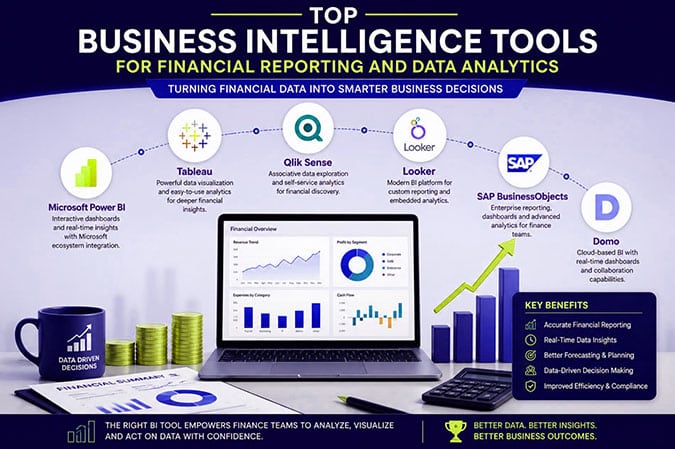
Platforms like Microsoft Power BI, Tableau, SAP BusinessObjects, Oracle Analytics Cloud, Qlik Sense, IBM Cognos Analytics, Looker, and Sisense each offer unique strengths for financial analysis and reporting.
The right BI solution depends on your company’s size, budget, technical requirements, and strategic goals. Small businesses may prioritize affordability and simplicity, while large enterprises often require advanced governance and predictive analytics capabilities.
As technology continues advancing, BI tools will become even more intelligent, automated, and accessible. Companies that invest in modern analytics platforms today will be better prepared to compete in a data-driven future.