Business Intelligence Strategies for Improving ROI and Operational Efficiency
In today’s highly competitive business landscape, organizations are under constant pressure to increase profitability while reducing operational costs. Companies that fail to adapt to data-driven decision-making often struggle to maintain growth, customer satisfaction, and market relevance. This is where Business Intelligence (BI) becomes a transformative force. By leveraging data analytics, reporting tools, and predictive insights, businesses can optimize processes, improve decision-making, and significantly enhance return on investment (ROI).
Business Intelligence is no longer limited to large corporations with extensive IT departments. Modern cloud-based platforms and advanced analytics tools have made BI accessible to organizations of all sizes. Whether a company operates in retail, healthcare, manufacturing, finance, or e-commerce, BI strategies can unlock opportunities for operational efficiency and long-term success.
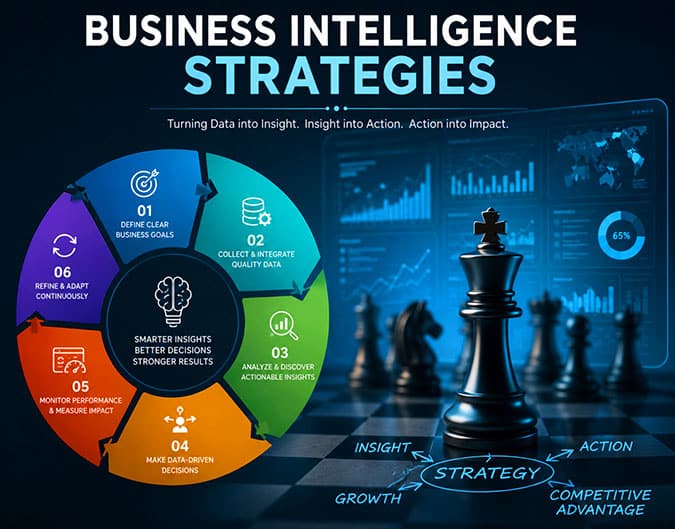
Understanding Business Intelligence
Business Intelligence refers to the technologies, applications, and strategies used to collect, analyze, and present business data. The primary objective is to support better decision-making through accurate and actionable insights.
BI systems typically include:
- Data collection tools
- Dashboards and reporting software
- Data visualization platforms
- Predictive analytics
- Artificial intelligence and machine learning integrations
These components work together to convert raw data into meaningful information that executives, managers, and employees can use to improve business performance.
Why ROI and Operational Efficiency Matter
ROI measures how effectively a company uses its resources to generate profit. Operational efficiency focuses on minimizing waste while maximizing productivity. Both are interconnected because efficient operations often lead to higher profitability.
Companies that implement effective BI strategies can:
- Reduce unnecessary expenses
- Identify profitable customer segments
- Improve supply chain performance
- Increase employee productivity
- Enhance customer satisfaction
- Accelerate decision-making processes
When organizations combine operational efficiency with data-driven insights, they create sustainable competitive advantages.
Establishing Clear Business Objectives
One of the most critical BI strategies is aligning analytics initiatives with business goals. Many organizations invest in BI software without defining measurable objectives, leading to poor implementation and limited ROI.
Before deploying BI systems, businesses should determine:
- What problems need solving
- Which metrics define success
- How data will support strategic decisions
- Which departments will benefit most
For example, a retail company may focus on reducing inventory waste, while a financial institution may prioritize fraud detection and risk management.
Clearly defined goals ensure that BI efforts remain focused and produce measurable outcomes.
Creating a Centralized Data Infrastructure
Data fragmentation is one of the biggest obstacles to operational efficiency. Many organizations store information across multiple systems, including spreadsheets, cloud applications, and legacy databases. This scattered approach creates inconsistencies and delays in reporting.
A centralized data infrastructure allows businesses to integrate information from multiple sources into a unified system. This strategy improves accuracy, accessibility, and collaboration.
Benefits of centralized data management include:
- Faster reporting
- Improved data consistency
- Reduced manual data entry
- Enhanced cross-department communication
- Better compliance and security
Data warehouses and cloud-based platforms are commonly used to centralize business information and support real-time analytics.
Leveraging Real-Time Analytics
Traditional reporting methods often rely on historical data that may already be outdated by the time decisions are made. Real-time analytics enable organizations to monitor operations continuously and respond quickly to changing conditions.
For example:
- Retailers can track customer purchasing trends instantly
- Manufacturers can identify production bottlenecks in real time
- Logistics companies can optimize delivery routes dynamically
- Customer service teams can address issues immediately
Real-time BI tools help businesses reduce downtime, improve responsiveness, and minimize costly errors.
Organizations that use real-time analytics gain a significant advantage because they can make proactive decisions rather than reactive ones.
Using Predictive Analytics for Strategic Planning
Predictive analytics uses historical data, machine learning, and statistical models to forecast future outcomes. This BI strategy allows businesses to anticipate trends, customer behaviors, and operational risks before they occur.
Predictive analytics can help organizations:
- Forecast sales demand
- Optimize inventory levels
- Reduce equipment failures
- Improve marketing performance
- Detect fraud patterns
- Predict customer churn
For example, an e-commerce company can use predictive models to recommend products based on customer browsing history. Similarly, manufacturers can predict equipment maintenance needs before costly breakdowns happen.
By anticipating future events, businesses reduce uncertainty and make more confident strategic decisions.
Improving Data Quality and Governance
Business Intelligence systems are only as effective as the quality of the data they process. Inaccurate or incomplete information can lead to poor decisions, financial losses, and operational inefficiencies.
Strong data governance ensures that information remains reliable, secure, and consistent across the organization.
Effective data governance strategies include:
- Establishing data quality standards
- Regularly cleaning and validating data
- Defining user access permissions
- Maintaining compliance with regulations
- Monitoring data usage and security
Organizations that prioritize data quality experience more accurate reporting and stronger decision-making capabilities.
Empowering Employees with Self-Service BI
Traditionally, employees relied heavily on IT departments to generate reports and analyze data. This approach often created delays and limited access to critical information.
Self-service BI platforms empower non-technical users to access dashboards, create reports, and explore data independently.
Benefits of self-service BI include:
- Faster decision-making
- Reduced dependency on IT teams
- Improved employee productivity
- Increased collaboration
- Better organizational agility
When employees have immediate access to relevant insights, they can respond more effectively to operational challenges and customer needs.
Training employees to use BI tools effectively is equally important. Organizations should invest in data literacy programs to ensure teams can interpret and apply insights correctly.
Enhancing Customer Experience Through BI
Customer experience is one of the strongest drivers of business success. BI strategies help organizations better understand customer preferences, purchasing behaviors, and satisfaction levels.
Businesses can use BI to:
- Personalize marketing campaigns
- Improve customer support
- Analyze buying patterns
- Identify high-value customers
- Measure customer satisfaction trends
For instance, subscription-based companies often analyze user engagement data to reduce churn rates and improve retention strategies.
By understanding customer behavior more deeply, businesses can create targeted experiences that increase loyalty and revenue.
Automating Business Processes
Automation is another essential BI strategy for improving operational efficiency. Repetitive manual tasks consume valuable time and increase the risk of human error.
BI systems integrated with automation tools can streamline processes such as:
- Financial reporting
- Inventory management
- Employee scheduling
- Customer communications
- Workflow approvals
Automation reduces administrative burdens while allowing employees to focus on higher-value activities.
For example, automated reporting systems can generate daily performance dashboards without requiring manual data compilation. This saves time and ensures consistent reporting accuracy.
Measuring Performance with KPIs
Key Performance Indicators (KPIs) are essential for evaluating business performance and tracking progress toward strategic goals.
Organizations should identify KPIs that align with operational and financial objectives, such as:
- Revenue growth
- Customer acquisition cost
- Inventory turnover
- Employee productivity
- Customer retention rate
- Profit margins
Interactive BI dashboards make it easier to monitor KPIs in real time and identify areas that require improvement.
Companies that consistently track performance metrics are more likely to detect inefficiencies early and implement corrective actions quickly.
Integrating Artificial Intelligence into BI
Artificial Intelligence (AI) is rapidly transforming the Business Intelligence landscape. AI-powered BI tools can analyze massive datasets faster and more accurately than traditional methods.
AI-driven BI capabilities include:
- Natural language processing
- Automated insights generation
- Anomaly detection
- Intelligent forecasting
- Recommendation engines
These advanced technologies help businesses uncover hidden patterns and opportunities that might otherwise go unnoticed.
As AI continues to evolve, organizations that integrate intelligent analytics into their BI strategies will gain stronger competitive advantages.
Overcoming Common BI Challenges
Despite its benefits, implementing BI strategies can present challenges. Common obstacles include:
- Resistance to change
- Poor data integration
- High implementation costs
- Lack of skilled personnel
- Inconsistent data quality
To overcome these issues, organizations should:
- Develop a clear BI roadmap
- Encourage a data-driven culture
- Provide employee training
- Start with scalable solutions
- Continuously evaluate performance
Successful BI adoption requires commitment from leadership and collaboration across departments.
The Future of Business Intelligence
The future of Business Intelligence is increasingly driven by automation, AI, and cloud technologies. Organizations are moving toward more agile, predictive, and user-friendly BI ecosystems.
Emerging trends include:
- Augmented analytics
- Embedded BI applications
- Mobile BI access
- Advanced predictive modeling
- Real-time AI recommendations
Businesses that embrace these innovations will be better positioned to adapt to changing market conditions and customer expectations.
Conclusion
Business Intelligence has become an essential tool for organizations seeking to improve ROI and operational efficiency. By transforming raw data into actionable insights, BI enables companies to make smarter decisions, optimize processes, and respond rapidly to market changes.
From predictive analytics and automation to centralized data management and AI integration, effective BI strategies create measurable business value. Organizations that invest in data-driven cultures and modern analytics capabilities can reduce costs, increase productivity, and strengthen customer relationships.
As technology continues to evolve, Business Intelligence will play an even greater role in shaping the future of business success. Companies that prioritize strategic BI implementation today will be better prepared to compete, innovate, and grow in the years ahead.