Business Intelligence Software for Enterprise Growth: Best Platforms Compared
In today’s data-driven economy, companies can no longer rely on intuition alone to make strategic decisions. Organizations generate enormous amounts of information every day from sales systems, customer interactions, supply chains, websites, and cloud applications. The challenge is not collecting data anymore — it is transforming that data into actionable insights. That is where Business Intelligence (BI) software becomes essential.
Business Intelligence software helps enterprises analyze data, monitor performance, identify trends, and improve decision-making through dashboards, reports, and predictive analytics. Modern BI platforms now integrate artificial intelligence, automation, and real-time analytics to support enterprise growth at scale. According to recent industry reports, AI-powered analytics and cloud-based BI adoption are accelerating rapidly across global enterprises.
This article compares the best BI platforms available today and explains how each solution supports enterprise growth.
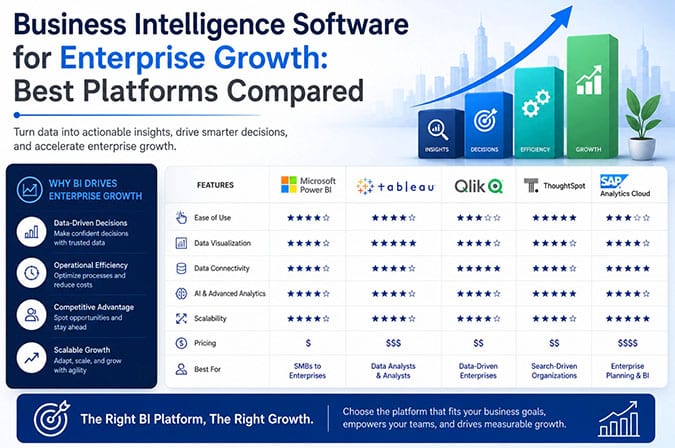
What Is Business Intelligence Software?
Business Intelligence software is a technology platform that collects, organizes, analyzes, and visualizes business data. These tools transform raw information into understandable reports and dashboards that executives, managers, and teams can use for strategic planning.
Typical BI software features include:
- Interactive dashboards
- Data visualization
- Predictive analytics
- AI-powered insights
- Data integration
- KPI monitoring
- Self-service analytics
- Real-time reporting
- Cloud connectivity
Modern enterprise BI solutions are designed to help organizations improve operational efficiency, reduce costs, identify new revenue opportunities, and enhance customer experiences.
Why BI Software Matters for Enterprise Growth
Enterprises that successfully leverage analytics often outperform competitors because they make faster and smarter decisions. BI platforms enable businesses to:
1. Improve Decision-Making
Executives gain access to real-time insights rather than waiting for manual reports. This leads to quicker responses to market changes.
2. Increase Operational Efficiency
BI tools identify bottlenecks, inefficiencies, and unnecessary spending across departments.
3. Enhance Customer Understanding
Analytics platforms reveal customer behaviors, purchasing trends, and engagement patterns.
4. Enable Data-Driven Culture
Modern BI tools empower non-technical employees to explore data independently through self-service dashboards.
5. Support AI and Predictive Analytics
Many enterprise platforms now integrate AI assistants, anomaly detection, and predictive forecasting. Industry analysts expect enterprise AI investment to exceed trillions of dollars over the next decade.
Best Business Intelligence Platforms Compared
Below are the leading BI platforms for enterprise growth in 2026.
1. Microsoft Power BI
Best For:
Organizations heavily invested in the Microsoft ecosystem.
Key Features:
- Deep integration with Microsoft 365 and Azure
- AI-powered Copilot tools
- Interactive dashboards
- Hundreds of data connectors
- Affordable enterprise pricing
Advantages:
Microsoft Power BI remains one of the most widely adopted BI tools globally because of its balance between affordability and enterprise functionality. Reports indicate that Power BI serves millions of users worldwide and maintains strong enterprise adoption.
Its tight integration with Excel, Teams, and Dynamics 365 makes it especially attractive for companies already using Microsoft technologies.
Drawbacks:
- Steeper learning curve for advanced DAX formulas
- Desktop application remains Windows-focused
Ideal Enterprise Use Case:
Large enterprises seeking scalable reporting with cost-effective licensing.
2. Tableau
Best For:
Advanced data visualization and storytelling.
Key Features:
- Industry-leading visual analytics
- Drag-and-drop dashboard creation
- Strong data exploration capabilities
- Salesforce integration
- Enterprise governance tools
Advantages:
Tableau is known for creating visually impressive dashboards that help enterprises identify trends quickly. It excels in exploratory analytics and is popular among data analysts and business users alike.
The platform also offers strong scalability for enterprise deployments.
Drawbacks:
- Higher pricing compared to competitors
- Can require technical expertise for complex deployments
Ideal Enterprise Use Case:
Organizations prioritizing visual storytelling and advanced analytics.
3. Looker
Best For:
Cloud-native enterprises using Google Cloud infrastructure.
Key Features:
- Semantic modeling with LookML
- Real-time cloud analytics
- Embedded analytics
- Strong governance capabilities
- BigQuery integration
Advantages:
Looker has become highly popular among enterprises seeking centralized data governance. Its semantic layer ensures consistent metrics across departments, reducing reporting inconsistencies.
Industry discussions frequently highlight Looker’s scalability and embedded analytics strengths.
Drawbacks:
- Requires technical expertise
- Setup complexity can be higher for smaller teams
Ideal Enterprise Use Case:
Data-mature organizations with strong engineering resources.
4. Qlik Sense
Best For:
Associative analytics and AI-driven insights.
Key Features:
- Associative data engine
- Augmented analytics
- AI-generated insights
- Self-service dashboards
- Real-time analytics
Advantages:
Qlik Sense stands out because users can freely explore relationships between datasets without predefined query paths. This flexibility helps uncover hidden insights that traditional BI tools may miss.
Its AI-driven recommendations also improve user adoption across enterprises.
Drawbacks:
- Licensing can become expensive at scale
- Some advanced features require training
Ideal Enterprise Use Case:
Enterprises requiring flexible, discovery-driven analytics.
5. SAP BusinessObjects
Best For:
Large enterprises with complex ERP ecosystems.
Key Features:
- Enterprise reporting
- Scalable architecture
- SAP integration
- Data governance
- Advanced scheduling tools
Advantages:
SAP BusinessObjects is designed for highly structured enterprise reporting environments. It integrates seamlessly with SAP ERP systems, making it ideal for multinational organizations.
Drawbacks:
- Older interface compared to modern competitors
- Implementation complexity
Ideal Enterprise Use Case:
Large corporations already operating SAP infrastructure.
6. IBM Cognos Analytics
Best For:
AI-powered enterprise reporting and governance.
Key Features:
- AI-assisted dashboard creation
- Automated insights
- Enterprise-grade security
- Natural language queries
- Advanced reporting
Advantages:
IBM Cognos focuses heavily on enterprise governance and AI-enhanced analytics. The platform supports highly regulated industries requiring secure reporting and audit capabilities.
Drawbacks:
- User interface can feel less modern
- Higher enterprise deployment costs
Ideal Enterprise Use Case:
Financial institutions and regulated enterprises.
7. ThoughtSpot
Best For:
Search-driven analytics.
Key Features:
- Natural language search
- AI-powered analytics
- Real-time insights
- Cloud-native architecture
- Self-service exploration
Advantages:
ThoughtSpot simplifies analytics by allowing users to search data similarly to using a search engine. This dramatically reduces barriers for non-technical business users.
Drawbacks:
- Premium pricing
- Less customizable than some competitors
Ideal Enterprise Use Case:
Fast-growing enterprises prioritizing accessibility and speed.
Cloud BI vs Traditional BI
Modern enterprises increasingly prefer cloud-based BI platforms over traditional on-premise systems.
Cloud BI Advantages:
- Lower infrastructure costs
- Faster deployment
- Easier scalability
- Remote accessibility
- Automatic updates
- AI integration
Traditional BI Advantages:
- Greater control over infrastructure
- Preferred in highly regulated industries
- Strong internal security management
Cloud analytics adoption continues growing rapidly because enterprises want faster innovation and lower maintenance burdens.
Key Factors to Consider When Choosing BI Software
Selecting the right BI platform depends on enterprise goals, technical maturity, and scalability requirements.
1. Integration Capabilities
Ensure the platform connects easily with ERP systems, CRMs, cloud applications, and databases.
2. Scalability
The platform should support growing data volumes and user bases.
3. AI and Automation
Modern enterprises benefit from predictive analytics, AI-generated insights, and automation tools.
4. Ease of Use
Self-service analytics reduces dependence on IT departments.
5. Security and Governance
Enterprise-grade security is critical for protecting sensitive business data.
6. Total Cost of Ownership
Licensing, implementation, training, and infrastructure costs should all be evaluated carefully.
Industry experts increasingly emphasize that workflow fit matters more than vendor hype when selecting enterprise platforms.
The Future of Business Intelligence
The BI industry is evolving rapidly with artificial intelligence becoming the biggest growth driver. Modern analytics platforms are shifting from static dashboards toward autonomous insight generation.
Emerging BI trends include:
- AI-powered analytics agents
- Natural language querying
- Automated anomaly detection
- Predictive forecasting
- Real-time decision intelligence
- Embedded analytics
- Unified semantic layers
Research indicates that enterprise AI adoption is accelerating across industries, making intelligent analytics platforms more important than ever.
Final Thoughts
Business Intelligence software has become essential for enterprise growth in the digital economy. The best BI platform depends on your organization’s infrastructure, budget, analytics maturity, and long-term strategic goals.
- Microsoft Power BI delivers exceptional value and ecosystem integration.
- Tableau remains the leader in data visualization.
- Looker excels in cloud-native governance.
- Qlik Sense offers flexible exploratory analytics.
- SAP BusinessObjects supports large ERP-driven enterprises.
- IBM Cognos emphasizes governance and AI reporting.
- ThoughtSpot simplifies analytics through search-driven experiences.
As AI and automation continue transforming enterprise analytics, companies that invest in modern BI platforms will gain stronger competitive advantages, faster decision-making capabilities, and deeper operational intelligence.